


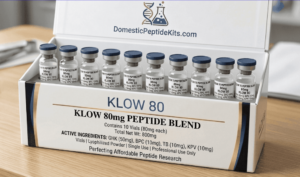

The Klow 80 Research Peptide Kit is one of the most advanced multi‑peptide blends available for recovery, inflammation balance, and cellular repair research. Researchers choose the Peptide because it combines four high‑value peptides—TB‑500, BPC‑157, GHK‑Cu, and KPV—into a single, powerful formula designed to support studies on tissue healing, collagen production, gut‑lining integrity, and immune modulation.
For those looking to Buy Klow 80, this kit delivers exceptional value by offering a complete multi‑pathway blend instead of requiring multiple separate vials. The Klow 80 Research Peptide Kit is batch‑tested, high‑purity, and RUO‑compliant, making it a trusted choice for labs and independent researchers who need consistent, reliable materials.
Klow 80 has also gained attention in research focused on helping women with KLOW, especially in studies involving recovery after physical stress, hormonal balance, skin health, and cellular rejuvenation. With GHK‑Cu for cosmetic and regenerative pathways, KPV for inflammation balance, and TB‑500 + BPC‑157 for tissue repair, the Klow 80 Research Peptide Kit offers a uniquely comprehensive profile for women’s wellness research.
Whether your goal is to Buy Klow 80 for recovery studies, inflammation research, or women‑focused wellness pathways, this kit provides unmatched quality and value. Domestic Peptide Kits delivers Klow 80 in simple, cost‑efficient packaging so researchers can focus on results—not marketing fluff. The Klow 80 Research Peptide Kit remains one of the most effective and reliable multi‑peptide blends for healing, regeneration, and advanced recovery research.
KLOW 80mg Peptide Blend consists of:
GHK-Cu: 50 mg
KPV: 10mg
BPC-157: 10 mg
TB-500 (Thymosin Beta-4 fragment): 10 mg
Benefits of KPV
Anti-Inflammatory Effects
- Reduces Inflammation: KPV effectively lowers the production of pro-inflammatory cytokines.
- Targets Inflammatory Pathways: It inhibits NF-κB, a key regulator of inflammation, helping to manage chronic inflammatory conditions.
Gut Health Support
- Restores Gut Integrity: KPV aids in healing the intestinal barrier, making it beneficial for conditions like inflammatory bowel disease (IBD).
- Promotes Gut Healing: It helps reduce inflammation in the gut and supports the recovery of damaged tissues.
Skin Health
- Improves Skin Conditions: KPV can reduce inflammation associated with skin disorders such as psoriasis and eczema.
- Enhances Wound Healing: It supports tissue repair and may improve skin texture and reduce scarring.
Four Peptides, Four Mechanisms: Why KLOW Exists
The peptide community didn’t invent KLOW out of thin air. It emerged from the observation that the GLOW protocol (GHK-Cu + BPC-157 + TB-500) worked well for tissue repair and skin rejuvenation but left one gap: it didn’t directly address systemic inflammation.
That’s a problem when healing needs to happen alongside an active inflammatory response. Think autoimmune flare-ups, chronic gut inflammation, or recovery from illness where the immune system is still running hot. BPC-157 and TB-500 both have anti-inflammatory properties, sure, but their primary mechanisms target tissue repair pathways. They reduce inflammation as a secondary effect.
KPV is different. It walks straight into the cell nucleus and shuts down NF-kB, the master switch controlling inflammatory cytokine production (Kannengiesser et al., Anti-Inflammatory Mechanisms, 2020). No other peptide in the GLOW stack does that.
KLOW Blend InjectedGHK-Cu 50mg
KPV 10mg
BPC-157 10mg
TB-500 10mg
Collagen & Elastin Synthesis
Gene Expression Modulation
NF-kB Pathway Inhibition
TNF-alpha & IL-6 Reduction
VEGF & Angiogenesis
Growth Factor Expression
Actin Regulation & Cell Migration
Stem Cell Differentiation
Tissue Regeneration
What’s Actually in a KLOW Vial
A standard KLOW vial contains 80mg total across four peptides in a fixed 5:1:1:1 ratio.
Component Amount % of Blend Role Research Status GHK-Cu 50mg 62.5% Collagen synthesis, gene modulation Well-studied individually KPV 10mg 12.5% Anti-inflammatory (NF-kB inhibition) Emerging research BPC-157 10mg 12.5% Tissue repair, angiogenesis Extensively studied (animals) TB-500 10mg 12.5% Cell migration, wound healing Well-studied individually GHK-Cu dominates the blend at 62.5%. That ratio reflects its naturally lower potency per milligram compared to the other three peptides and the fact that effective GHK-Cu doses (1-3mg daily) are significantly higher than effective BPC-157 doses (250-500mcg daily).
Breaking Down Each Component
GHK-Cu: The Collagen Engine
GHK-Cu (glycyl-L-histidyl-L-lysine copper complex) is a tripeptide naturally present in human plasma. Your body produces it. Levels decline with age: roughly 200 ng/mL at age 20, dropping to about 80 ng/mL by age 60.
What makes GHK-Cu unusual is scope. A 2018 analysis in the International Journal of Molecular Sciences found it affects 31.2% of human genes, modulating everything from collagen production to antioxidant enzyme expression. A separate 2015 study in Biomedical Research International measured a 70% increase in type I and III collagen and improved elastin production in skin tissue treated with GHK-Cu.
The copper ion isn’t decorative. It’s an essential cofactor for lysyl oxidase, the enzyme that cross-links collagen and elastin fibers. Without copper, those fibers form but don’t properly connect.
Molecular weight: 404.96 Da | Half-life: 0.5-2 hours | Sequence: Gly-His-Lys-Cu2+
KPV: The Inflammation Kill Switch
KPV is a tripeptide derived from the C-terminal fragment of alpha-melanocyte-stimulating hormone (alpha-MSH). It carries alpha-MSH’s anti-inflammatory properties without causing skin darkening. Three amino acids.
The mechanism is direct. KPV enters cells and inhibits NF-kB signaling at the nuclear level, reducing production of TNF-alpha and IL-6 (Kannengiesser et al., 2020). A 2021 study on psoriasis models showed 60% reduction in psoriatic inflammatory markers. In IBD models (2019), KPV reduced intestinal inflammation and supported barrier repair.
Critically, KPV doesn’t cause immunosuppression the way corticosteroids do. It modulates inflammation rather than blanket-suppressing immune function. That distinction matters for long-term use.
Half-life: 1-2 hours | Delivery: Injectable, oral, topical, nasal
BPC-157: The Healing Workhorse
BPC-157 has the deepest research base of the four. Over 100 animal studies spanning three decades. It’s a 15-amino-acid synthetic peptide derived from a protein found in human gastric juice, and it works primarily through VEGF-mediated angiogenesis and growth factor expression.
The strength of BPC-157 is breadth. Tendons, muscles, ligaments, gut lining, nerves, blood vessels. A 2017 study demonstrated enhanced VEGF expression and new blood vessel formation at injury sites. A 2020 safety evaluation found no serious adverse effects at 1000mcg/kg for 90 days in animal models.
The weakness is human evidence. Only three published human studies exist as of early 2026, all small pilot studies. A 2024 pilot on interstitial cystitis (12 patients) showed 80-100% symptom resolution. Promising, but far from definitive.
Molecular weight: 1,419.53 Da | Half-life: under 30 minutes | 15 amino acids
TB-500: The Migration Signal
TB-500 is a synthetic fragment of thymosin beta-4, the principal actin-sequestering protein in mammalian cells. It regulates cell migration, which is the process of cells moving toward injury sites.
TB-500 has stronger human data than BPC-157. A 2012 Phase 2 trial in Dermal Wound Healing studied chronic pressure ulcers. A 2016 cardiac trial demonstrated over 50% improvement in left ventricular function post-myocardial infarction. A 2014 Phase 2 trial showed benefit for dry eye (corneal healing).
The longer half-life (approximately 2 hours versus BPC-157’s 30 minutes) means TB-500 distributes systemically. It doesn’t need to be injected near the injury.
Molecular weight: 4,963.44 Da | Half-life: ~2 hours | 43 amino acids
With a half-life of ~2 hours you will need to have a kit or 2 for extended research and proper control of the variables. This is the perfect example of why DPK was made to make high cost items like KLOW 80 more affordable to the masses who are interested in the RUO possibilities of the peptide. A quick AI search, “What’s the average price of 1 bottle of KLOW 80 gives you exactly: $300 – $450 per bottle!!! So why wait!? Trust is earned, so that’s why we will be at more events showing off our low prices and exceptional products.KLOW vs GLOW: Which One?
This is the question everyone asks. The answer depends on what problem you’re trying to address.
GLOW KLOW Components GHK-Cu + BPC-157 + TB-500 GHK-Cu + KPV + BPC-157 + TB-500 Total vial 70mg 80mg Primary focus Skin rejuvenation, tissue repair Tissue repair + systemic inflammation KPV included No Yes (10mg) Best for Aesthetic recovery, wound healing, anti-aging Gut inflammation, autoimmune, complex recovery Injection site reactions More common (anecdotally) Less common (KPV may reduce them) Price Lower (3 peptides) Higher (4 peptides) The practical decision point: is active inflammation part of your picture?
If you’re dealing with a sports injury, post-surgical recovery, or skin rejuvenation without an underlying inflammatory condition, the GLOW protocol covers those bases. Adding KPV to that scenario provides marginal benefit.
If you’re dealing with gut issues (IBD, leaky gut, chronic digestive inflammation), autoimmune flares, or any situation where the immune system is contributing to the problem, the KPV component makes KLOW the more targeted choice. KPV’s ability to inhibit NF-kB at the nuclear level addresses root-cause inflammation in a way the GLOW stack can’t.
Our Commitment
As a small, family-owned business, DPK reinvests revenue into education, growth, and improved logistics. We believe researchers deserve access to dependable peptide kits at competitive prices. If you find a comparable kit priced lower, contact us — we want to ensure you always receive the best value.
Internal & External Links
- Explore our full range of Research Peptide Kits.
- Review peptide research guidelines at the National Institutes of Health.
- Link to Peptidewiki Research Peptide Wiki
Why Choose Domestic Peptide Kits?
DPK is a chosen destination to buy peptides online. We are a trusted Research Peptide vendor with formulations that meet and exceed industry standards and comply with quality regulations in USA to ensure product safety and efficiency. We specialize in all with a heavy focus on GLP-1 Research, and Health Extension Science investments
If you’re looking for a Klow 80 Peptide Kit or our well‑known “Wolverine” Blend (TB‑500 & BPC‑157), you’re in the right place to save real money. Visiting the big “fancy” shops — the ones pushed on social media with glossy labels and heavy marketing — is actually useful. Once you’ve tried them, you quickly see how fast the costs add up.
That’s exactly why we built this website. We want researchers to continue their work without being punished by inflated prices. We provide the same high‑purity peptides, backed by testing, but without the unnecessary branding costs. No flashy labels. No hype. Just clean white boxes, simple labels, and honest pricing.
When two vials of Tirzepatide elsewhere cost as much as an entire kit here at Domestic Peptide Kits, the difference becomes obvious. Our reputation is built on quality — everything else is noise. We’re here to fill a missing piece in the market and do it with transparency and fair pricing.
Our products are routinely and rigorously tested for purity, with Certificates of Analysis (COAs) verifiable through independent third-party laboratories.
We also maintain reliable customer service to ensure a smooth experience, from pre-sale inquiries to after-sales support. For any questions about our products please email us: Admin@domesticpeptidekits.com or even call us. We Offer customer Service above and beyond.


Reviews
There are no reviews yet.